Saturday, 25 August 2012

Chapter 10 Piecing. A method of cutting and seaming

This designing method is based on the traditional Seminole patchwork method.

I have developed tonal columns using paper and then fabric, these have become more fragmented as  I have worked.

Paper samples first with working sheet below

DSCF2518DSCF2520ws ch 10 page 1

Fabric sample 1 [front and back views]

DSCF2539DSCF2542

ws ch 10 page 2ws ch10 page 3

Fabric sample 2 Creating a mosaic pattern

The process of cutting and seaming repeatedly [see working sheet above]. So glad I photographed as I worked as it would have been impossible to appreciate the nature of the changes. Photos show front and back views.

DSCF2529DSCF2488

DSCF2490

DSCF2492

DSCF2494

DSCF2495

DSCF2497

DSCF2499

DSCF2501DSCF2502

DSCF2504DSCF2505DSCF2506DSCF2508DSCF2530DSCF2532

DSCF2535DSCF2537

Paving in Lisbon

DSCF2361

What did this remind me of?

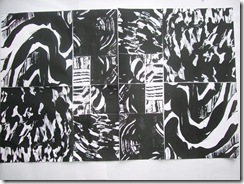
My black and white monoprinting in module 2!

The way in which the stones had been laid created a fascinating optical illusion

Saturday, 28 July 2012

Summer School 2012

Under the guidance of our tutor Sandra Meech we used painted, torn and cut papers and fabrics to make our own collaged compositions which were transferred onto fabric
Then our painted papers and colour and black and white photocopies were washed with Brusho paints before being ripped, torn and stitched used to make a stitch bound book according to the personal themes we’d chosen.
I’m delighted with mine and have been wanting to do something like this for a long time. The subject I chose was very evocative for me as I have many happy memories associated with it,
My subject was my Godmother’s Old garden Door which stood in the garden of her old farmhouse on the top of the Mendip Hills in Somerset which I used to run through back and forth  when I was little. This door no longer exists sadly and has been replaced by a polished new one! So I have photos of my brother’s garden door as he lives next door to the original so the local stone is featured and I have the garden doors in my local park in Brighton. It seems to me that all garden doors hold their own mystery and wonder.
My Godmother was an artist but suffering from Parkinson’s disease she lost the use of her hands towards the end of her life but undaunted she told me that she could still paint with words and she left us with two published books of poems and her personal memoirs
These are the two poems I’ve used as the theme for my book:
poem the old garden doorpoem garden of my life cropped
Here are some of my favourite ages from my book:
GG1
DSCF2424
DSCF2464
DSCF2465
DSCF2433
DSCF2450
DSCF2466
DSCF2445
DSCF2441
DSCF2448
DSCF2432
DSCF2431
DSCF2457DSCF2437
DSCF2429GG3

Sunday, 10 June 2012

Amendment!

An amendment to the title of chapter 9.

Of course I mean the Golden Section!

Chapter 9 The Fibonacci sequence and Golden Circle

We’ve been asked to research and create some samples around the concepts of the Fibonacci Sequence and Golden Circle which I have found both fascinating and challenging, this was largely new to me so great to learn something new – I now notice it everywhere!


The first pieces of research:

ch 9 1

ch 9 2

Starting to design by developing a tonal column arranged in tonal and width order making use of the Fibonacci sequence

Samples 1 & 2a

ch 9 3

Sample 2b

ch 9 4

Sample 3.   And then arranged differently….

ch 9 5

Sample 4. A patterned paper and plain paper arranged according to the Fibonacci Sequence

DSCF2263

Sample 5. And then cut at right angles and in turn spaced using the Fibonacci sequence

DSCF2240

Sample 6 . With strips from previous sample flipped lengthwise

DSCF2268

Sample 7. New Fibonacci strip using 5 patterned papers in tonal order and several copies made for following samples

ch 9 6 sample 7a

Sample  7b. And duplicated with dark tonal column from the original in the centre

DSCF2272

Sample 8. Previous sample cut into strips and shifted slightly creating a new pattern

DSCF2274

Sample 9. Same strips used to create a square design

DSCF2275

Sample 10. Taking a previous starting ‘block sample’ and cutting it into strips to be arranged in diagonal [45 degree angle] pattern to make a new design – quite a bit of work here so read on the  image below [sample 10a]

ch 9 7 sample 10a

Sample 10b.Trying to flip alternate strips didn’t give the results I wanted but still interesting!

DSCF2278

Sample 10c. Sample 10a was then cut again into diagonal strips to make another pattern

ch 9 sample 10c

Sample 10d. And then into vertical strips…….ch 9 8 sample 10d

Sample 11. A simple example of the Golden Section using patterned papers

ch 9 9 sample 11a

Sample 11b. Same  principle using different patterned papers to reflect original

ch 9 10 sample 11b

Sample 11c. And developed into a composite design…
DSCF2300

Sample 11d. I then drew the Golden Section spiral on all four  quarters of the composite design [see working sheet] and then swapped around the pieces cut away from outside for a more diverse pattern.

DSCF2296

Working sheets:

ch 9 ws 1ch 9 sw 2ch 9 ws 3ch 9 ws 4ch 9 ws 5